Quiet Luxury, Loud Craft: How “Made in Italy” Became the Global Benchmark Again
Quiet Luxury, Loud Craft: How “Made in Italy” Became the Global Benchmark Again
For readers assessing luxury Italian furniture, the practical question is how the idea performs in a real room, not only how it photographs. Salone del Mobile.Milano closed its 64th edition on 26 April 2026 with 316,342 visitors from 167 countries, up 4.5 percent on 2025, 68 percent of them from outside Italy, and 1,900 brands in the halls at Rho Fiera. The theme was “A Matter of Salone,” a year organised around materiality. What the floor mostly did not show was logos. The decade’s dominant taste asks an object to prove itself without a badge, which moves the burden of proof onto the people holding tools.

Quiet luxury moves the argument to the object
Quiet luxury is defined by subtraction: no conspicuous logos, no markers of price, no shortcut to status. Strip those out and something else has to carry the argument. In furniture that something is narrow and physical. Whether the grain runs continuously across two door fronts. Whether a drawer stays square after ten winters of a house drying out and taking on damp again.
Each is a production decision taken months earlier by someone with a specific skill. Which is why the trend has been better news for Italian manufacturing than for Italian branding. A logo can be redrawn in an afternoon. A grain-matched veneer layup cannot be improvised, and neither can the person who cuts it.
What the label legally means, and what it does not
Here the story gets less romantic. “Made in Italy” is not a quality certificate. Its legal core is customs law. Under the EU Union Customs Code, Regulation 952/2013, goods made entirely in one country originate there under Article 60(1); where two or more are involved, Article 60(2) assigns origin to the country of the last substantial, economically justified processing. The test does not ask what share of the hours, the value or the skill was Italian. A related practical reference is available in Pendant Lighting for Kitchen Island: Spacing, Height, Glare, and Task-Light Decisions.
Italian law polices the claim rather than defining the quality behind it. Article 4(49) of Law 350/2003 makes false or misleading indications of origin a criminal matter under Article 517 of the penal code. A stricter wording is protected separately: Law 166/2009 reserves “100% made in Italy” and “tutto italiano” for goods designed, manufactured and packaged entirely in Italy. Two phrases, two legal tests, sold side by side in the same showroom.
Italy did try to go further. Law 55/2010 would have required at least two manufacturing phases to happen in Italy, but the implementing decree was never issued, single-market objections were raised at European level, and the law sits on the books unapplied.
| Wording | Legal basis | What must happen in Italy | Status |
|---|---|---|---|
| “Made in Italy” as an origin mark | EU Union Customs Code, Art. 60; policed by Law 350/2003, Art. 4(49) | The last substantial, economically justified processing | In force |
| “100% made in Italy” / “tutto italiano” | Law 166/2009, Art. 16 | Design, manufacture and packaging, entirely | In force, fines €10,000–€250,000 |
| Two-phase rule for furnishing and textiles | Law 55/2010 | At least two manufacturing phases, rest traceable | Passed, never made applicable |
So the mark under a table tells you where the last significant step happened, not who cut the veneer. Which sharpens the question: if the legal protection is this thin, why has Italian furniture held the benchmark at all? This decision can also be compared with the site’s guide to Maxalto: The Antonio Citterio Heritage Collection from B&B Italia.
The answer is a district, not a factory
The economist Giacomo Becattini spent decades on that puzzle, reworking Alfred Marshall’s nineteenth-century idea of the industrial district to explain post-war Italy. His district is not a big plant. It is a socio-territorial unit where a community and a population of small firms overlap so completely that society and industry cannot be separated, each firm specialising in one product or one phase. His sharpest point was scarcity: a skill that looks ordinary inside one valley can be unobtainable on the world market.
Italy’s statistics office measures them. Working from the 2011 census, Istat identified 141 industrial districts, forty fewer than in 2001, together roughly a quarter of the country’s productive system: 24.5 percent of workers, 24.4 percent of local units.
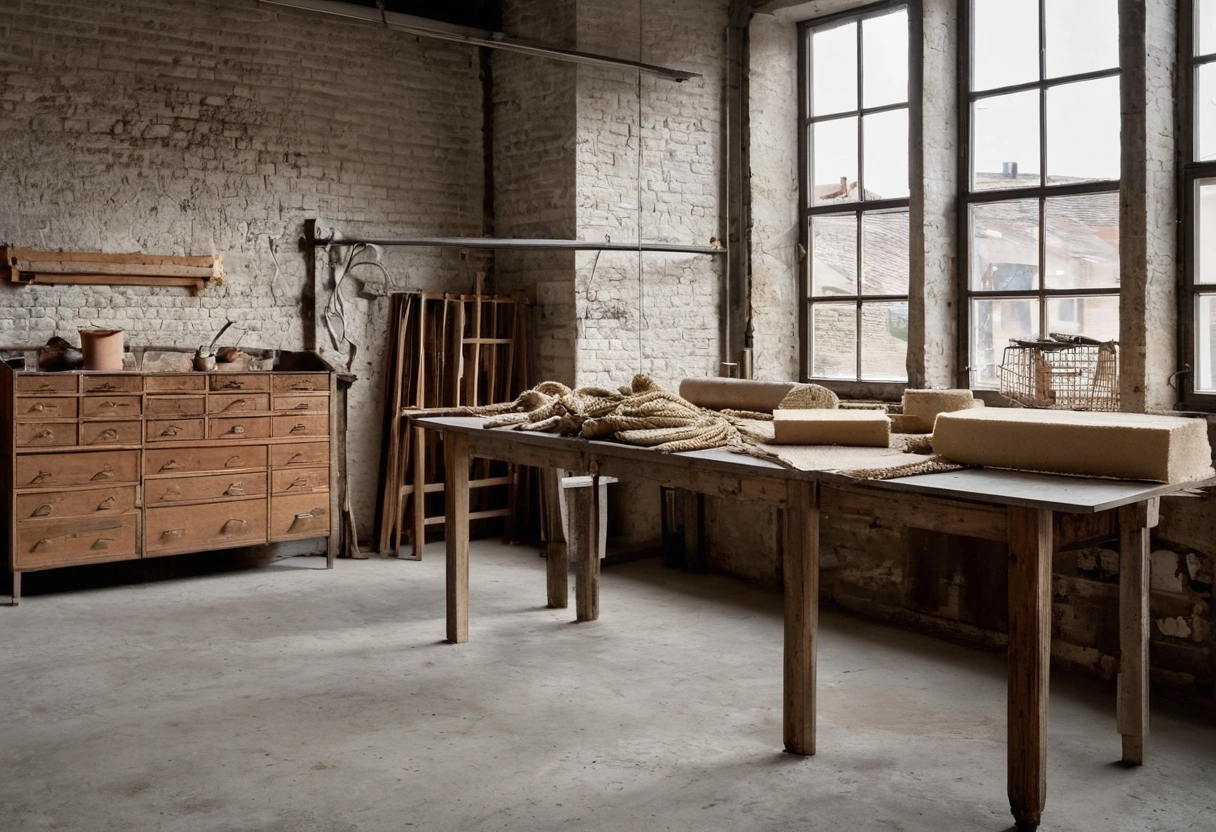
The furniture one sits between Milan and Lake Como. Unioncamere’s survey of the Brianza district describes a population of mostly very small businesses, craftsmanship the dominant element, a handful of larger firms working alongside. Its firms cover carving, inlay work, polishing, lacquering and gilding, then glass, metals, plastics and padding. Furnishing the Villa Reale in Monza pulled the trades into one place, and the real expansion ran from 1945 to 1960 as incomes rose. The wider project context is available from modinewslibrary.com.
A gilder who has been gilding for thirty years, three streets from the frame-maker he has worked with since both were apprentices, is not a supplier you can source. He is a place.

The arithmetic of fragmentation
The scale is national, the structure still tiny. The study centre at FederlegnoArredo reported that Italy’s wood-furniture chain closed 2025 above €52.2 billion, up 1.4 percent, with exports of €19.3 billion, more than 66 percent of them absorbed by Europe. The chain runs to more than 62,000 companies and over 292,000 employees, 2.3 percent of GDP.
Divide the workforce by the company count and the character of the system falls out: fewer than five people per firm, on average, across an industry that ships nineteen billion euros abroad. Not large plants with brands bolted on, but thousands of small specialists within driving distance of each other, and a few hundred firms that know how to conduct them. Slow to build, slow to rebuild, bad at spectacle, good at what a logo-free object has to get right.
- Distretto industriale
- An area where many small firms specialise in phases of one industry and are socially, not just commercially, bound to it. Istat counts 141 nationally.
- Last substantial transformation
- The customs test under Article 60(2) that decides origin when more than one country worked on a product.
- Terzista
- A specialist subcontractor working to another firm’s drawing. The typical district firm, and the reason a label rarely names who did the work.
Reading the claim before you buy it
Since the label settles less than buyers assume, the useful questions are about the chain, not the flag. A firm that builds classic Italian furniture in its own workshops should answer all of them without pausing. For the next stage of the brief, see About Us.
- Ask which phases happen where. Frame, veneer, carving, finishing, upholstery. The origin mark is compatible with several answers; a maker inside a district will tell you.
- Ask who the specialists are. A district firm knows its gilder and its foundry by name.
- Ask for the stronger claim. If a piece qualifies under the 2009 rule, that is a legal statement with fines behind it, not a slogan.
- Ask about repair. A system of small specialists can refinish, reupholster and recarve decades later. A chain assembled for one season cannot.

Rome has noticed what it has. Law 206/2023 gathered the subject into a single statute of 59 articles, set a National Made in Italy Day on 15 April, funded a supply-chain fund and created a Made in Italy school track. Legislation cannot manufacture a gilder, and a public holiday cannot compress an apprenticeship. But the policy concedes what the market already decided.

The benchmark is not the phrase. It is what the phrase points at when it happens to be true: a hundred and forty-one districts, sixty-two thousand mostly tiny firms, and trades that took two centuries to concentrate north of Milan. Quiet luxury did not create that. It removed the logo standing in front of it.